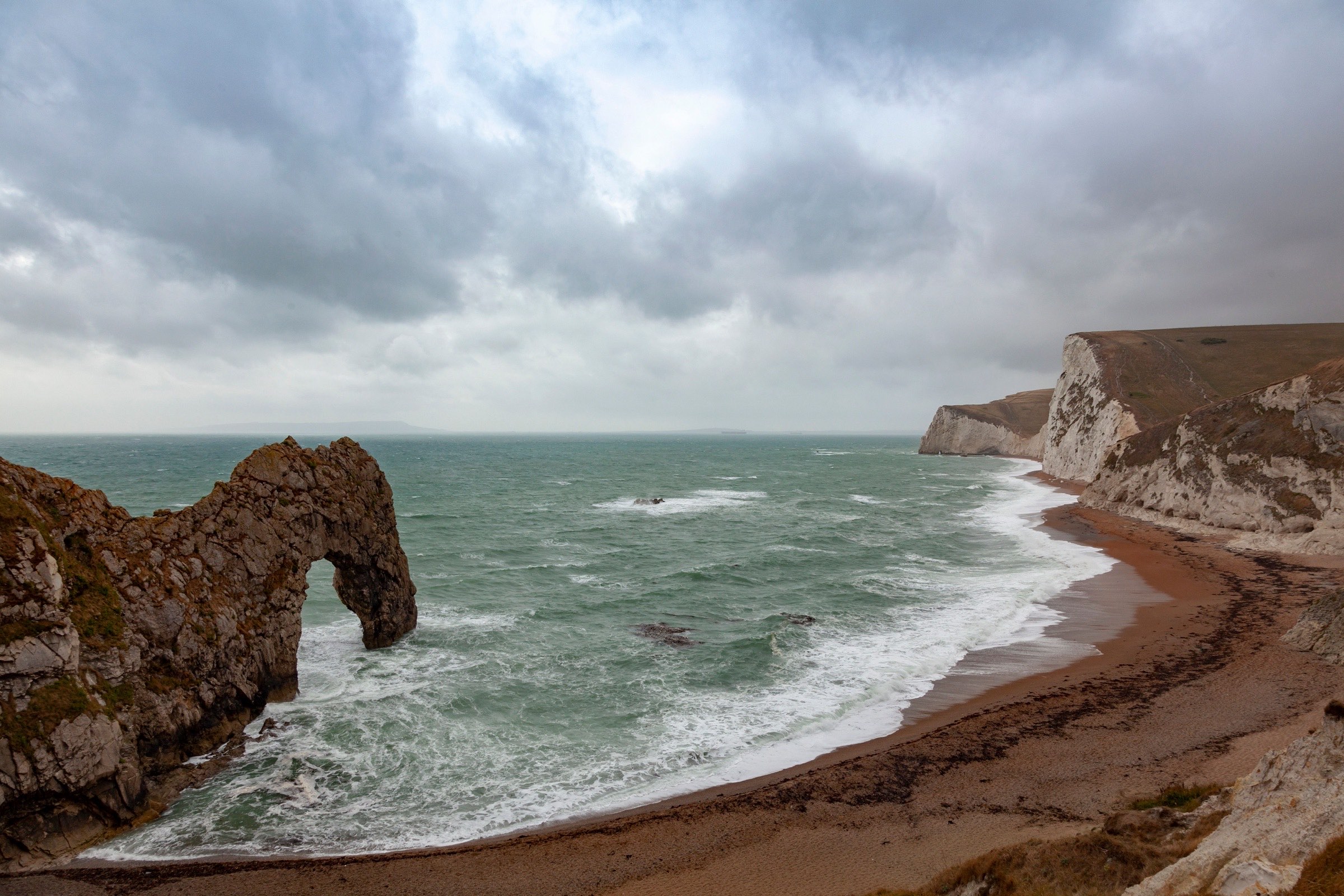
Durdle Door and Lulworth Cove share the same rock. The sea broke through the same band of Portland limestone at both places, roughly ten thousand years ago at Durdle Door, and the result looks almost nothing alike twice over: an arch at one end, a near-perfect circular bay at the other, a mile of coast path between them.
The walk between the two
The path climbs steeply out of Lulworth almost immediately, over Hambury Tout, before dropping down to Durdle Door on the far side. It’s roughly a mile each way, chalk and limestone underfoot rather than sand, and steep enough in both directions that a fit dog will manage it more easily than an owner carrying a bag for two. Stair Hole sits just past the Lulworth end of the path: a smaller, unfinished version of Lulworth Cove itself, the sea still working on the same rock today, which is as close as this coastline gets to showing its own working. The folded, contorted layers visible in the rock here have their own name, the Lulworth Crumple, and geologists have been coming to study them since the 1830s, drawn by five different rock types exposed within a few hundred metres of each other. The Geological Society of London rates the cove as one of the clearest examples in Europe of how a coastline erodes in stages, which is a precise claim for somewhere that mostly gets photographed for the view.
A calmer swim than Durdle Door’s
Lulworth Cove itself is shingle rather than sand, calm enough inside the bay for a dog to swim without much surf to contend with, since the near-circular shape blocks most of the swell that reaches Durdle Door’s more open beach directly. Both beaches allow dogs, though it’s worth checking current access before a longer stay, since rules along this stretch of coast are set by the same local, annually reviewed accreditation covered elsewhere in this collection.
Crowds, and how to dodge them
Both car parks fill by mid-morning on a clear day, and the walk between the two gets correspondingly busy on the same stretch everyone else is also trying to photograph. Arriving early, or starting from Durdle Door’s car park instead, buys more space on the path rather than a queue for the view.
The Bull, the Blind Cow, the Cow and the Calf
Durdle Door’s famous sea stumps, the eroded remains of a collapsed arch further along the shore, have their own names: the Bull, the Blind Cow, the Cow and the Calf. Working out which is which is a good way to keep a dog occupied while everyone else queues for the same photograph.
Terrain, and a fossil forest you can’t quite reach
The path itself is well maintained but not flat: steps in places, loose chalk in others, and no shade for most of the mile between the two. Underfoot, this is closer to Dartmoor’s granite than to a beach walk, worth remembering if the plan is sandals rather than boots. A fossilised forest sits just east of the cove too, tree stumps turned to stone roughly 145 million years ago, though the best-preserved sections currently sit inside the boundary of the Lulworth Ranges rather than on the open path.
Further along, if the ranges are open
East of Lulworth Cove, the coast path runs into the Lulworth Ranges, more than 2,800 hectares used by the army’s Armoured Fighting Vehicles Gunnery School, and access depends entirely on the firing schedule. When the ranges are open, most weekends and school holidays, the walk continues past Worbarrow Bay to Tyneham, a village evacuated for military training in 1943 and never resettled, its school and church still standing empty. It’s worth checking the current access dates before planning around it, since the exact pattern shifts year to year, but it’s a different walk entirely to anything at Lulworth or Durdle Door itself.
Where to base yourself
Both sit within reach of the cottages we curate across Dorset, close enough for a full day between the cove, the arch and the path connecting them without an early start. Starting from the Lulworth car park means the steep climb comes first and the walk back is downhill; starting from Durdle Door reverses that, which suits a dog who tires on the way home rather than the way out. This stretch is also a short section of the same South West Coast Path covered elsewhere in this collection, so anyone walking further along the Jurassic Coast will cross this exact mile again from a different direction eventually. It’s worth treating this as one unhurried day rather than a stop on the way to somewhere else, since the mile between the two rewards slow walking more than fast.