A big house, built for a crowd, for a long weekend that used to run from Saturday to Monday rather than Friday to Sunday. That’s not a description of a modern group booking. It’s the British country house party, and it was doing exactly this a century before anyone thought to add a dog to the guest list.
The Golden Age of the Saturday to Monday
Between the 1860s and 1914, the British country house party was at its peak, and the phrase used for it wasn’t “weekend” at all. Guests came from Saturday to Monday instead, since “weekend” implied you had a job to get back to on Monday morning, and implying that was exactly the point being avoided. A former butler recalling his Edwardian childhood said every county had thirty or forty big houses like this, each with a staff to match: thirty or forty servants was standard for a house running parties of this size.
The dogs who actually worked these weekends
Days followed a set shape: shooting in the morning, elaborate meals throughout, parlour games and music once evening came. None of it ran on house dogs guests brought with them, because there weren’t any. It ran on a separate population entirely: working gundogs, kept in purpose-built kennels well away from the house and looked after by a gamekeeper rather than a guest.
The larger estates kept extraordinary numbers of them. In 1922 the 3rd Earl of Durham housed nearly sixty labradors, spaniels and flatcoated retrievers at Lambton Castle, plus a handful of separate “night dogs” kept purely for security. The Duke of Portland never kept fewer than thirty labradors at Welbeck Abbey around the same time.
The Labrador itself was a recent arrival to all this. The Kennel Club didn’t recognise it as its own breed until 1903, the same year golden retrievers were first allowed to register at all, and both spent years competing against the flatcoated retriever, the dominant sporting dog of the decades before. A dog on one of these estates was bred, bought, trained and worked, with cost attached to every stage of it: one Edwardian duke’s surviving accounts show him paying the equivalent of several hundred pounds in today’s money for a single Clumber spaniel pup. None of that investment had anything to do with companionship. It was working capital, housed in a kennel block down by the gamekeeper’s cottage, not a spare room in the main house.
Why it all came apart
The end came from two directions at once. Death duties, introduced in 1894, climbed steeply through the twentieth century, reaching as much as 80 per cent on the largest estates by the 1940s and 50s. At the same time, the First World War and then the Second pulled an entire generation of servants toward better-paid work elsewhere, and they didn’t come back afterwards. A house built to run on thirty or forty staff couldn’t run on none.
What happened to the houses
Roughly 1,200 country houses in England alone were demolished between 1900 and the 1970s, too expensive to maintain and too expensive to leave standing empty. The scale of it is hard to picture now: in 1912, Country Life magazine ran an advertisement offering the roofing balustrade and urns from Trentham Hall, one of the great Staffordshire houses, for two hundred pounds, and the house itself came down not long after with barely any public comment at all. It took until 1974, and a landmark exhibition simply called The Destruction of the Country House, for the scale of what had been lost to register with the public and for serious conservation efforts to follow in earnest.
The ones that survived mostly changed jobs rather than owners: schools, hotels, golf clubs, apartment blocks, or handed over to the National Trust, which set up a dedicated Country Houses Committee in 1936 specifically to try to save the ones it still could.
The same idea, minus the below-stairs
What’s left of that world, big houses built for a crowd rather than a nuclear family, are exactly the properties that suit a modern group holiday best, wherever they’re found. Large-house letting for weddings, reunions and group breaks has grown into its own corner of the UK hospitality market precisely because these houses already had the one thing a modern group actually needs: enough rooms under one roof for everyone, built at a scale nobody builds a private house at any more. The basic shape hasn’t changed much: a large house, several families under one roof, days built around one shared activity rather than several separate ones.
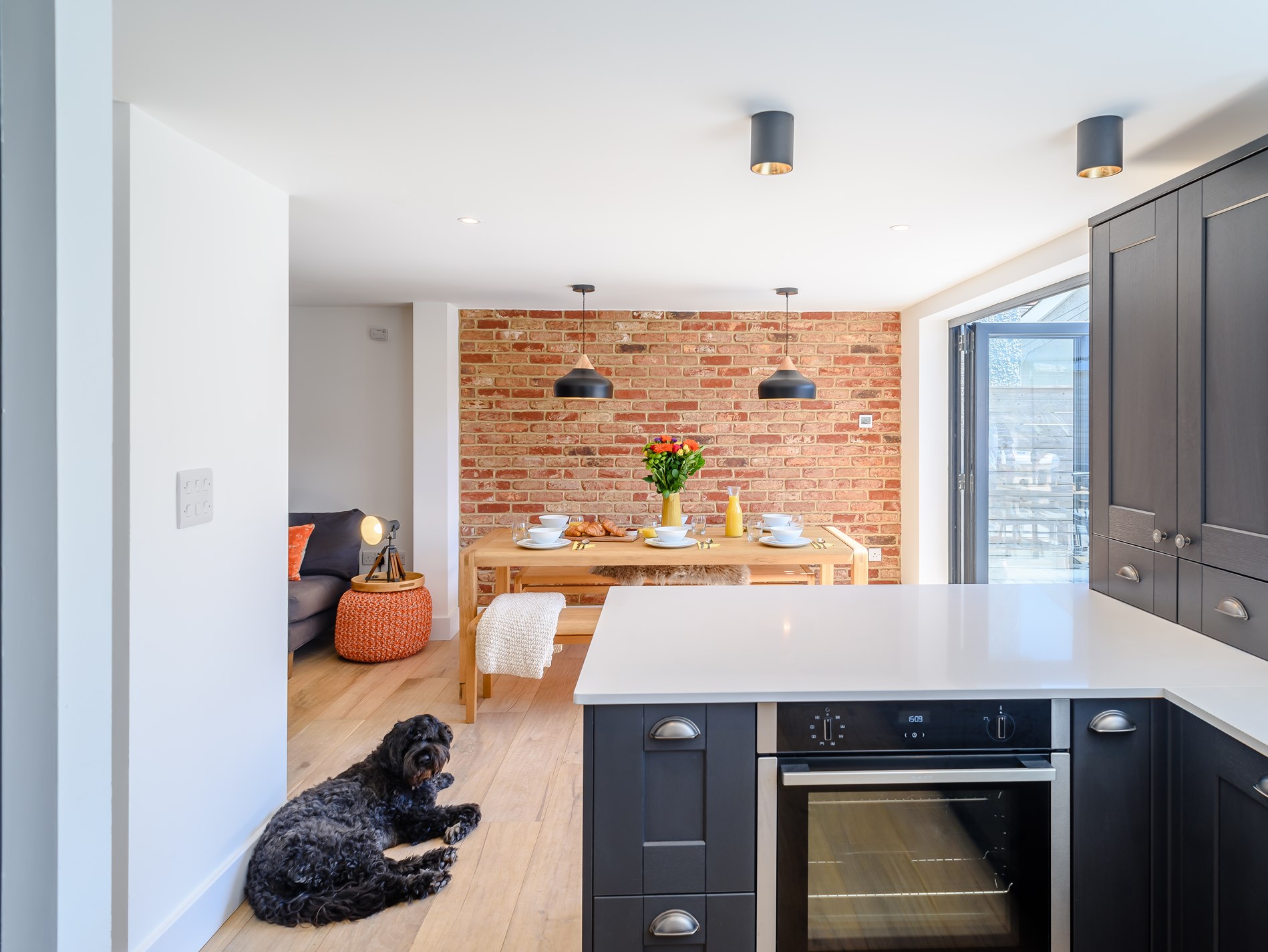
What’s gone is the staff running it invisibly in the background. What’s changed completely is the dog. A hundred years ago, if one was part of a Saturday to Monday at all, he was a working gundog living in a kennel block by the gamekeeper’s cottage, bred and bought for a job, not for company. Today, in a Together-tagged property in this collection, that’s exactly where he ends up instead: not in a kennel down the drive, but in the room with everyone else.
The country house itself took a parallel route back from the brink, one that runs through the National Trust and the Landmark Trust rather than a shooting party: our guide to how the country house became a holiday let covers how the same big houses ended up let out by the week.